09/28/99
By Patricia Lowell / Special Contributor to The Dallas Morning News
Karen Freize and her 15-month-old daughter, Alexandra, are very discriminating about how they play. They prefer soft toys with lots of shapes, textures and colors, and during playtime they listen to classical music or children's tunes with lots of rhyming lyrics. "At this age, everything a child does is a learning opportunity," says Mrs. Freize, a geriatric nurse who is taking several years away from work to be with her child. "So I want to be sure that we're making the most of these years." At their Garland home, even lunchtime is learning time. Alexandra's place mats are maps of the continents.
The "competitive edge" of grown-up society is creeping down to children and even babies, as many parents increasingly are focusing on building their child's intellectual foundation before they can even say "IQ." But does the effort pay off? Medical science in recent years has offered parents a whole range of answers to that question. Study after study has encouraged parents to do their best to offer an enriched environment to children during the first three years of their lives because these early years are an irreplaceable window of lifelong learning. Some studies indicate that exam scores and college acceptance letters may be determined, in part, by something as simple as the kind of music the baby listens to at bedtime.
As a result, a whole industry has been created to satisfy the urge to build baby brain power. From motor-skill-developing toys to rooms painted in stimulating hues to videos targeted to the stroller set, parents are now shopping for birthday gifts at teacher supply stores, while day-care centers are replacing their Barney soundtracks with Mozart concertos.
The only problem with these practices, says John T. Bruer, Ph.D., author of the just-released book The Myth of the First Three Years (The Free Press hardcover, $25), is that they are not upheld by science. For the past 14 years, Dr. Bruer has been the president of the James S. McDonnell Foundation, an organization that funds neuroscience research programs throughout the world. "At this time, there is no neuroscience research indicating that there is anything magical about the first three years of a child's life," Dr. Bruer says. "The conclusions that have been reported come from bits and pieces of information extracted from research and intended to support our Western beliefs about child-rearing. And many of these theories are completely unfounded by medical research." Dr. Bruer says mistakes and misunderstandings occur when trying to assimilate brain research into mind research. He says the two areas of study are distinct and separate.
There are three major "myths" that Dr. Bruer tries to dispel in his book:
* A child's nerve synapse growth can be increased with improved environment. Not so, argues Dr. Bruer. An improved environment will not increase growth, he says, although nerve synapse growth can be lessened if there is injury or damage to the brain. Nerve synapse growth comes naturally as a child matures.
* The first three years are a "limited-time-only window." On the contrary, Dr. Bruer points out that neuroscience has proven brain development continues well into adulthood.
* The belief that "enriched" environments improve brain development.
"In these studies, an enriched environment is anything other than living in a rat cage in a laboratory," Dr. Bruer says. "A lab environment can hardly be compared to the average home environment." Not surprisingly, many experts, from child psychologists to child care advocates to lobbyists for child-friendly legislation, disagree with Dr. Bruer. They stress that any positive time spent with a child helps development - even if it's just cuddle time.
"I think the thing about research is that it is an ever-evolving process," says Cristin Dooley, a child-life specialist at Children's Medical Center of Dallas. "What is important is for young children to have positive experiences - whether that be with music, play, structured activities or just bonding with parents. It's these positive experiences, not flash cards at 6 months, that help children grow and learn."
The focus on parents promoting intelligence during the infant years is a new concept - about 10 years old. Don Campbell, a musician, educator and creator of The Mozart Effect music recordings and books, is one of the earliest advocates of enriching a child's environment. "Parents realize that we are now living in a very competitive world, and they want their kids to be happy, healthy and smart," Mr. Campbell says. "Today's parents are striving to give their children a good balance of these three components. I think it's fair to say that all parents truly want what's best for their children. And as education and awareness about child development increases, so do the options for parents who want to do the best they can for their kids."
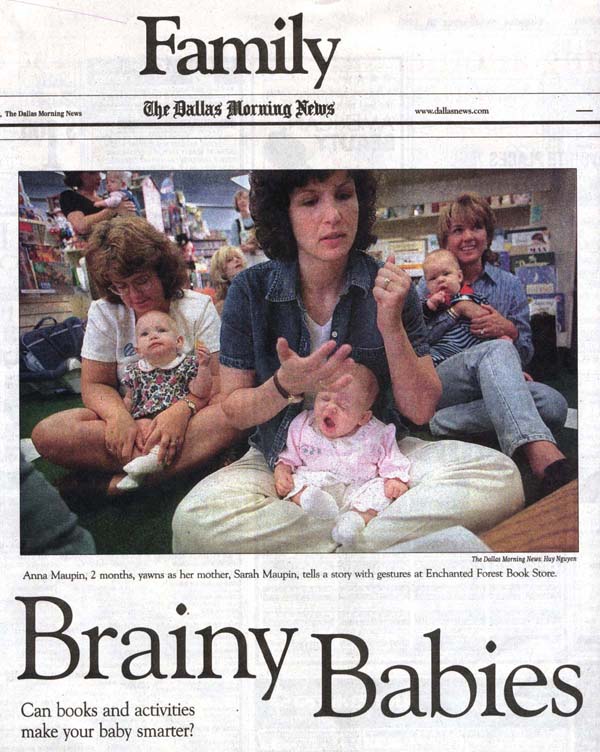
At Enchanted Forest children's bookstore in Dallas, babies up to 18 months participate in their own baby book club. Teacher and presenter Susan Minshall entertains groups of book-biters and bubble-chasers at her twice-weekly B.Y.O.B. (Bring Your Own Baby) events. "Our goal is to have moms and babies interact with books in a way that helps children develop a love of reading," says Mrs. Minshall, who adds that her class strives for fun and reading skills, not intelligence building. "We focus on reading with inflection, learning finger plays and songs, so that children and their parents can share some enjoyable learning activities with their children."
Mrs. Minshall's motto is, "If you read, you succeed," and she encourages parents to focus on the three R's - rhythm, rhyme and repetition. "When I first began this program, I was surprised to learn just how many moms are out there looking for something fun and beneficial to do with their babies," says Mrs. Minshall, who has anywhere from 25 to 35 moms and babies in her group.
Although experts may disagree on how to build a child's brain power - and even the question of whether or not one should try - they do agree on the importance of spending one-on-one time with babies in order to promote emotional bonding. "There is no toy or tune or activity that can replace a parent's attention," Ms. Dooley says. "The sense of self-esteem that children develop from having their parent's attention is as critical to success in life as any degree or IQ score."
Patricia Lowell is a Dallas free-lance writer.